












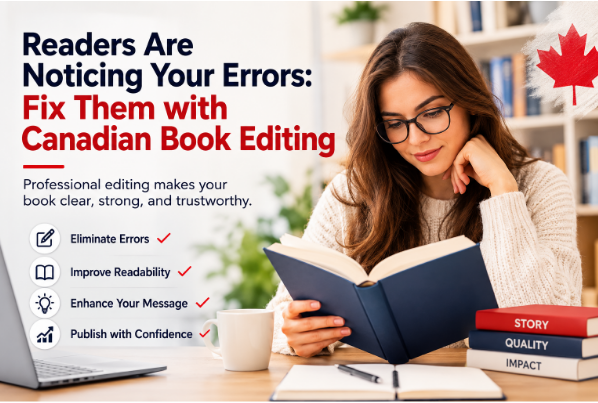
Completion of a manuscript is something that warrants celebration. However, having completed writing the last chapter does not automatically mean that your book is ready for publication. Authors spend months or years developing their ideas and plots, but forget the significance of proper editing. This results in small mistakes staying unnoticed until the time readers start spotting them and mentioning them in reviews.
Regardless of the publishing process being traditional or independent, today’s readers require polished text. No matter how fascinating a story could be, its effect will be diminished by grammatical mistakes, awkward sentences, and wrong formatting. Editing allows authors to transform a manuscript into a book that conveys ideas fluently and confidently.
Why Readers Notice Errors More Than Authors
An author spends so much time crafting his manuscript that he is bound to be acquainted with all the sentences he has used. This acquaintance can make it hard for him to spot any missing words, repeated statements, or confusing explanations. It is the nature of the mind to read what it thinks it will read rather than what it actually reads.
An objective view offered by the editor can help point out all those problems that the author has overlooked because of his familiarity with the manuscript. The aim of an editor is not to alter the style of the author but to make his writing more coherent.
Common Problems That Affect Reader Experience
Other books also suffer from such problems despite the fact that they have been edited numerous times by their writers. These include the following:
- Typographical mistakes
- Punctuation and spelling errors
- Inconsistencies in names of characters
- Inconsistent timelines
- Redundancy
- Complicated sentences
- Poor paragraph transitions
- Inconsistencies in formatting
- Grammatical mistakes
Although each of the above-mentioned problems is trivial in nature, their combination could result in an inferior product. Readers may begin to mistrust the writer because of such mistakes.
Why Self-Editing Has Its Limits
Self-editing is an integral part of the writing process, yet it cannot be the only one. The writer knows the meaning of each sentence because he or she has written it. However, readers do not see anything but what is written on paper.
Professional editing creates another level of quality assurance. An editor reviews the manuscript from the reader’s point of view and finds places where some thoughts may sound confusing or where text can be restructured for better flow. Such editing makes the text easier to read without changing its meaning.
Even experienced writers continue collaborating with editors as they know that all manuscripts need an unbiased check.
Different Types of Book Editing
Editing is not a one-size-fits-all process. Each phase of editing emphasizes something different about the manuscript.
| Type of Editing | Purpose | When Should It Be Done? |
| Developmental Editing | Improve structure, organization, pace, and all-around content | Once you finish your first draft |
| Line Editing | Improve sentence structure, tone, and readability | Once you’ve perfected your structure |
| Copy Editing | Fixes grammatical issues, punctuation, and consistency | Once you’re done with the copy-editing stage |
| Proofreading | Find remaining spelling, punctuation, and formatting errors | Just before the manuscript goes live |
Knowing this can help authors determine which type of editing they need for their manuscript rather than assuming that a single editing phase will fix everything.
How Professional Editing Builds Reader Trust
An edited book becomes a much more comfortable read all the way to the end. The reader will be able to concentrate on the plot, ideas, or facts without getting distracted by avoidable mistakes. Good writing will help the readers comprehend even complicated issues better.
Professional editing results in consistency between different chapters, improves logical flow, and preserves the author’s meaning throughout the manuscript. This is often an indicator of the book’s success among the readers, positive reviews, and the author’s credibility.
No matter what kind of book you are writing, fiction or nonfiction, editing shows your respect towards the reader and the time spent creating your book.
How Careful Editing Supports Long-Term Success
Publishing a book may just be the start of an author’s journey. Those who like a good book that was edited properly will surely suggest that book to others and purchase other works from the same author in the future. On the contrary, if there are too many mistakes, then the reader will think twice before buying any other book by the same author.
Good editing also makes the author feel more confident while sharing their ideas. Regardless of the author’s intention to entertain, teach, or inspire people, they should not have any problems expressing their thoughts in proper English.
Editing will be more effective for writers who intend to publish a new book if it is done in combination with an entire publishing plan. After editing the manuscript, the writer can move on to designing, distributing, and marketing the book using the Best Book Promotion Services in Canada.
Preparing a Manuscript Before Sending It to an Editor
Despite the significant contribution of editors to improving texts, the process will be much smoother for both parties if the author does a final self-check beforehand.
Preparation tips:
- Read the manuscript out loud to find awkward phrasing.
- Look for redundancies and unnecessary sentences.
- Make sure all names, dates, and facts are correct.
- Maintain consistency in chapter format.
- Wait for a few days before revisiting the manuscript for review.
It does not replace professional editing, but makes the process much easier.
Editing Is Only One Part of a Quality Publishing Process
Upon completion of the editing process, most writers will proceed to cover design, formatting, printing, and distribution. All these steps make up the overall reading experience. A professionally edited manuscript should also be professionally printed and distributed in order to maintain a high standard from the very beginning to the end.
If one writes a book and plans to print the physical copy, then it makes sense to compare Book Printing companies in Canada in order to produce the book to its full potential, since the printing standards, paper quality, and bindings all influence the total reading experience.
Prior to finishing each step of the publishing process, many authors seek advice and professional assistance. One can find valuable information about the whole process of manuscript preparation and publication at www.bookwriters.ca.
Conclusion
Typos may be forgiven on occasion, but constant mistakes will detract from the very best content or story. Editing will increase consistency, readability, and clarity without sacrificing the unique style of the author. It will contribute to making a better reading experience that results in positive responses and credibility.
All manuscripts should be professionally reviewed before being published. Spending time editing will enable writers to feel comfortable presenting their work and readers will get what they expect to see in a completed book.