














Ask any student what they dread most about Maths or Science revision, and “remembering all the formulas” is near the top of the list. There are so many of them trigonometry, mensuration, physics, chemistry and they slip away just as fast as they’re learned. Students feel this pressure keenly, but here’s something often missed: parents and teachers can make a real difference in how well those formulas stick.
The key is knowing how to help. Nagging a child to “revise your formulas” rarely works. But a few simple, science-backed approaches from the adults around them can turn formula revision from a dreaded chore into something that actually sticks.
Why Formulas Are So Easy to Forget
First, it helps to understand the problem. Formulas are usually learned as isolated facts — short, abstract, and disconnected from meaning. Our brains are poor at holding on to information like that, especially when it’s only read repeatedly rather than actively used.
Most students “revise” by staring at a formula list until it feels familiar. That familiarity is a trap: recognising a formula on a page is very different from recalling it in an exam with the page gone. This is exactly where parents and teachers can step in with better methods.
What the Research Says Actually Works
Two ideas from how memory works should guide everything here.
The first is active recall — testing yourself instead of re-reading. A student who tries to write down a formula from memory learns it far better than one who reads it ten times. The second is spaced practice — revisiting a formula across several days rather than cramming it once. Each time you recall something after a short gap, the memory gets stronger.
Almost every tip below is really just a way of getting a student to recall formulas, repeatedly, over time — with a parent or teacher making that happen gently.
How Parents Can Help at Home
You don’t need to understand the formulas yourself to help your child revise them. What you can offer is structure, encouragement, and a bit of friendly testing.
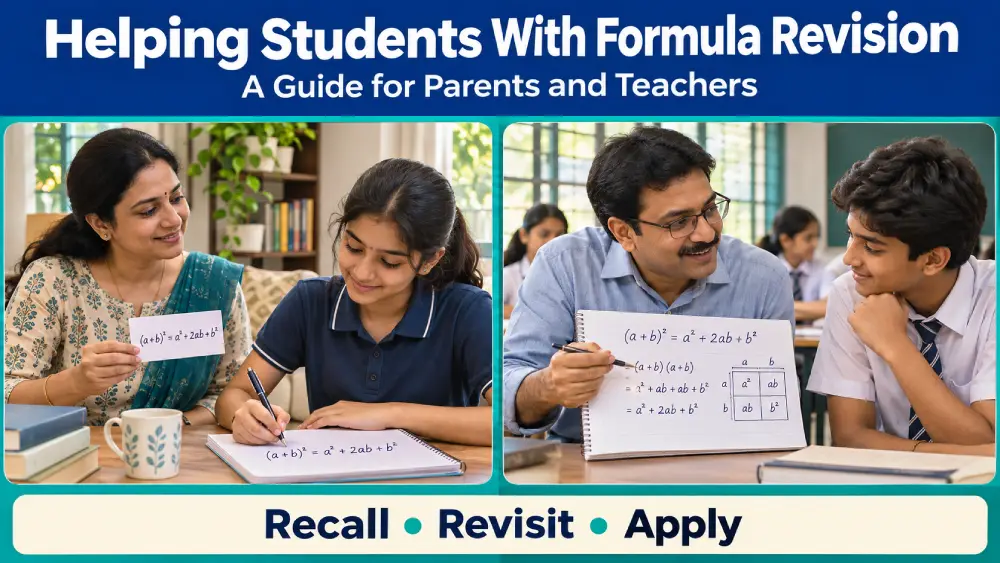
Hold the formula sheet and ask your child to recite or write a few formulas from memory — turn it into a quick, low-pressure quiz rather than an interrogation. Do this for five minutes a day across the week, not all at once. Celebrate when they get one right, and stay calm when they don’t; the goal is practice, not judgment.
A ready reference makes this easy. Keeping a consolidated Class 10 Formula Sheet on hand means you can quiz your child even if you’ve long forgotten the maths yourself you just read the answer and check. Stick a copy on the study-room wall, too, so formulas become part of the everyday background.
Most importantly, keep the mood light. A stressed child remembers less. Your encouragement matters more than your subject knowledge.
How Teachers Can Help in the Classroom
Teachers have the biggest lever of all: regular, low-stakes practice built into normal lessons.
Start classes with a quick two-minute formula recall — no grades, just retrieval. Connect each formula to its meaning or derivation, so students understand why it works instead of memorising blindly; a formula understood is a formula remembered. Use formula charts on classroom walls, encourage students to make their own sheets, and let them teach formulas to each other, which forces real recall.
Crucially, bring formulas back repeatedly across the term rather than teaching them once and moving on. That spacing is what turns short-term cramming into long-term memory.
Parents and Teachers: Who Does What
The two roles work best together. Here’s a simple split:
| Parents can… | Teachers can… |
| Run short daily formula quizzes using a sheet | Start lessons with quick recall drills |
| Keep the environment calm and encouraging | Explain the why behind each formula |
| Display formula sheets at home | Use wall charts and student-made sheets |
| Ensure regular, spaced practice | Revisit old formulas across the term |
| Praise effort and understanding | Set application and reasoning questions |
Move From Memorising to Applying
Knowing a formula isn’t the finish line — using it is. Exams increasingly test whether students can apply a formula to an unfamiliar problem, not just state it.
So once the basics are solid, encourage practice with application-style questions. For senior students, higher-order resources like the CBSE Class 12 Question Bank push students to pick the right formula for a new situation, which is exactly the skill exams reward. Teachers can set these in class; parents can simply make sure their child is practising problems, not just reading formulas. NCERT remains the base for the concepts themselves — the application practice builds on top of it.
Common Mistakes Adults Should Avoid
- Pushing rote memorisation. Formulas learned without understanding vanish fastest.
- Turning revision into pressure. Anxiety hurts memory; a calm tone helps it.
- Cramming it all at once. Spaced, little-and-often practice beats one long session.
- Only reading, never testing. Recall is what builds memory, not re-reading.
- Ignoring application. Knowing a formula isn’t enough if the student can’t use it.
Small, Steady Support Makes the Biggest Difference
Helping a student with formula revision isn’t about being a maths expert or spending hours each day. It’s about a few minutes of friendly testing at home, regular low-stakes recall in class, a formula sheet within reach, and a calm, encouraging tone from everyone around them.
Do that consistently, and formulas stop being the thing students dread. They become something revised a little every day, understood rather than crammed, and remembered when it counts. That steady, shared support from parents and teachers is quietly one of the most powerful study tools a student can have.
FAQ
How can parents help with formula revision if they don’t know the subject? You don’t need to know the formulas. Hold a formula sheet, quiz your child briefly each day, check their answers against the sheet, and keep the atmosphere calm and encouraging. Your structure and support matter more than subject knowledge.
What’s the best way to revise formulas so they stick? Use active recall (writing formulas from memory rather than re-reading) and spaced practice (revisiting them across several days). These two methods are far more effective than staring at a formula list.
How can teachers help students remember formulas? Run short, no-grade recall drills in class, explain the reasoning behind each formula, use wall charts and student-made sheets, let students teach each other, and revisit old formulas regularly across the term.
Is memorising formulas enough for exams? No. Exams increasingly test application — using a formula in an unfamiliar problem. Students should practise application and reasoning questions, not just memorise formula lists.
How often should students revise formulas? A little every day beats one long session. Short, spaced recall practice across the week keeps formulas in long-term memory far better than cramming.
How do we keep formula revision from becoming stressful? Keep it short, low-stakes, and encouraging. Treat it as quick daily practice rather than a test, praise effort, and stay calm about mistakes — a relaxed student remembers more.